Functional printing: A new era for manufacturing

For a long time, it was said that printing would become obsolete and be replaced by other technologies. However, the tide has now turned, and in some cases traditional manufacturing processes are even being replaced by printing technologies. This growing market, known as functional printing, enables the production of electronic components, smart surfaces and advanced coatings, thereby opening up entirely new possibilities in sectors such as electronics, healthcare and renewable energy.
What exactly is functional printing and how does a functional printed product reach the market?
Functional printing differs from conventional printing in that it is not primarily about visual impact. Instead, structured layers of functional materials are applied to create electrical, optical or mechanical properties on a substrate.
Some of the most interesting applications at present are:
- Printed electronics: sensors, RFID antennas and flexible printed circuits
- Energy applications: batteries, solar cells and other energy-generating devices
- Smart surfaces: optical filters, illuminated displays and interactive materials
- Medical and biotechnological applications: biosensors, lab-on-a-chip devices and drug-delivery patches
Unlike conventional manufacturing processes such as etching, deposition, casting or milling, functional printing offers a cost-effective, scalable alternative for the production of components made from advanced materials.
From concept to production

The path to commercialising a functional printing product is complex. Every project requires bespoke development, which typically goes through the following five key phases:
- Concept and Feasibility Study
In this phase, companies assess whether a functional printing solution is technically feasible and economically viable. Can a printed component replace a conventionally manufactured part? Are the material and production costs reasonable? - Prototyping
Once a concept has been proven to be feasible, small-scale prototypes are produced using 3D printers in the laboratory. These prototypes serve to refine ink formulations, substrates and printing processes before they are deployed on a larger scale. - Pilot production
This phase bridges the gap between prototyping and industrial production. Here, the product is manufactured in limited quantities on an upgraded production line whilst simultaneously being certified, tested for compliance and validated under real-world conditions. - Integration into production
For a functional printed product to be used commercially, it must be integrated into existing production processes. In this phase, quality control, automation and process stability are optimised to ensure high yield and minimal waste. - Large-scale industrial production
The final step is mass production. However, functional printing presents a particular challenge: paradoxically, the printing processes are often too productive for current market demand. A single narrow-web or sheet-fed printing press could, in theory, print all the solar panels in the world. Costs and yield must therefore be carefully balanced.
A glimpse into the future
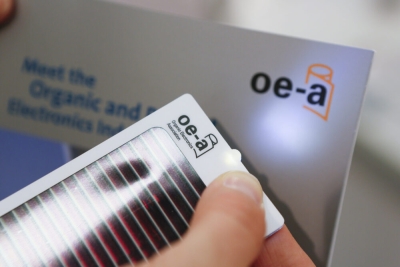
Functional printing is transforming the electronics, energy and healthcare sectors. The path from the laboratory to mass production still presents a whole host of further challenges. We’ll explore these in a future blog post and take a look at how various printing technologies are suited to functional printing, what advantages and limitations they have, and, above all, what potential they hold.
FAQ – Frequently Asked Questions
Functional printing refers to the manufacture of components and products in which printed layers of material perform an electrical, optical or mechanical function. The focus is therefore not on visual design, but on the technical properties of the printed product.
The most important applications include printed electronics, sensors, RFID antennas, flexible printed circuits, solar cells, batteries, optical filters, illuminated displays and biosensors. Lab-on-a-chip systems and medicated plasters can also be produced using functional printing processes.
Development typically takes place in five phases: concept and feasibility study, prototyping, pilot production, integration into existing production processes, and large-scale industrial production. During this process, materials, printing processes, quality assurance and cost-effectiveness are optimised step by step.
Functional printing can be a cost-effective and scalable alternative to processes such as etching, casting or milling. It enables the use of advanced materials, flexible product designs and the manufacture of complex components with potentially lower material consumption.