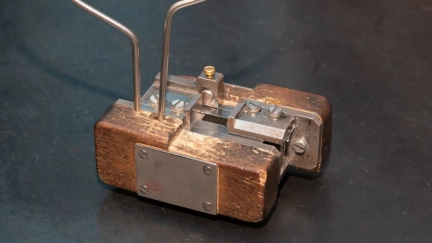
Gutenberg’s Inventions – Part 1: The Type Block and the Type Matrix
In our series, guest author Dr Julia Bangert from the International Gutenberg Society in Mainz e.V. will be presenting Johannes Gutenberg’s inventions one by one. We begin with the male and female moulds.
Johannes Gutenberg’s invention of letterpress printing with movable type is based on a simple yet ingenious principle: the text is broken down into its smallest components – the letters and punctuation marks. These individual building blocks, in the form of metal letters, can be rearranged time and again to form different texts. What is impressive about Gutenberg’s achievement is that he invented or developed all the necessary components for a complete, complex system for the mechanical printing of texts. Everything works so well together that the process has remained virtually unchanged for centuries.
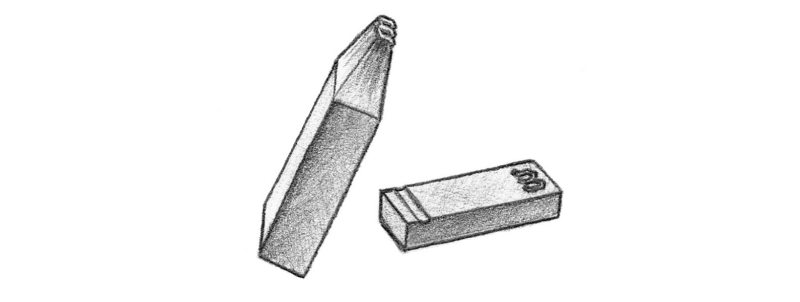
Punch
The first part of Gutenberg’s invention was the production of moulds for printing type. First, a letter is engraved in reverse and raised on the tip of a hard metal rod, such as steel. This creates a punch. Such punches for embossing letters were already known in Gutenberg’s time and were used, for example, by goldsmiths. In 1444, Gutenberg was described in a list of the inhabitants of Strasbourg as a “Zugeselle” of the goldsmith guild. However, this is not synonymous with a full member. As a patrician, Gutenberg was not a goldsmith, but he had the necessary technical knowledge and worked closely with a large team of craftsmen, experts and financiers for his invention.
Matrix
The punch is punched into a piece of softer metal, such as copper. The result is a deepened and laterally correct image of the letter and thus a casting mould. This mould as the counterpart to the punch is called the matrix. With a matrix any number of type or “sort” can be cast. As the underlying moulds of a font, the matrices were of great value to the printers and were carefully stored so that new, identical sorts could be cast if necessary.
FAQ – Frequently Asked Questions
A punch is a hard metal rod on which a letter or punctuation mark is engraved in raised, mirrored form. It is used to create a mould for casting printing type.
A matrix is a casting mould made by striking a punch into a softer metal, such as copper. It contains a recessed, correctly oriented image of the letter.
The punch is the raised, mirrored stamp. The matrix is the recessed mould created by the punch. The matrix is then used to cast individual pieces of movable type.
Punches and matrices made it possible to cast identical pieces of movable type repeatedly. This allowed printers to reassemble letters and punctuation marks into different texts and reuse them for new print jobs.

About the author:
Julia Bangert holds a Ph.D. in Book Studies and is an artist. In 2019, her dissertation was published under the title 'Book Trade System and Knowledge Space in the Early Modern Period.' She works freelance as a book painter and illustrator. Her signature style features the finest use of color and an elegant brushstroke, with perfect gold leafing as her passion.
One of her ongoing projects is the illumination of Bible pages, which can be purchased in the shop at the Gutenberg Museum in Mainz.