Printing holograms using an inkjet printer

Holograms are a popular feature frequently used in security printing to prevent the counterfeiting of banknotes, credit cards and identity documents. However, applying holograms to cards or banknotes can be a time-consuming and complicated process. Researchers at ITMO University in Saint Petersburg, Russia, have now found a way to print holograms using a standard inkjet printer and a specially formulated nano-ink. The benefits: significant time and cost savings.
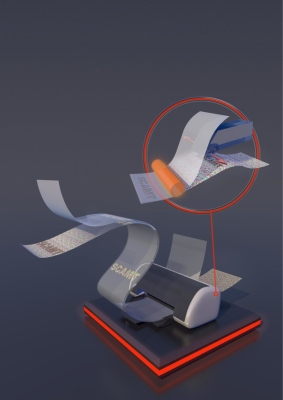
The team of scientists, led by Alexander Vinogradov, a senior research fellow at the International Laboratory of Solution Chemistry of Advanced Materials and Technology at ITMO, developed a colourless ink made from nanocrystalline titanium dioxide. In the next step, they applied the ink to micro-embossed polyethylene terephthalate-based paper using a standard inkjet printer. The ink covered the microscopic structure of the paper, creating a patterned image. The paper was then coated with varnish to preserve the image. The ink enables individual holographic images to be printed onto transparent films within a few minutes, rather than taking days as with conventional methods.
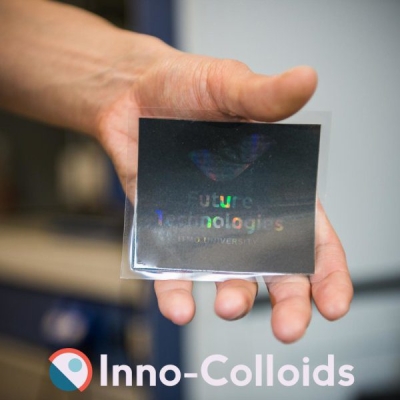
Conventional methods have been in use since the 1960s, but one of their biggest drawbacks was the time required to produce a hologram. The first step was to develop a master hologram, which was then usually recorded using a laser onto a thin layer of light-sensitive polymer. The polymer layer served as a template for a metallic matrix, into which a micro-relief was then embossed. The entire process was highly sensitive to environmental conditions such as temperature fluctuations and vibrations. “The rapid and effective printing of individual holographic images is a challenge that has remained unresolved until now,” says scientist Aleksandr Yakovlev.
The team claims that producing holograms using inkjet printers could reduce costs significantly, enable the reproduction of images of any size and ultimately lead to the creation of unique, individual holograms within a matter of minutes. The article describing the process was published on 17 November in the scientific journal *Advanced Functional Materials*.
The cost and time savings are clearly an advantage for packaging companies that have previously been unable to utilise holographic printing due to the time and expense involved. However, the cost and effort involved in holographic printing were one of the factors that made holograms so valuable as a security feature, as they could not be easily copied. Although the new process still requires special ink and paper, it remains to be seen whether it will affect the usefulness of holograms as a security feature.
FAQ – Frequently Asked Questions
A specially formulated nano-ink made from nanocrystalline titanium dioxide is applied to micro-embossed PET-based paper. The printed image is then protected with a varnish.
The process can speed up the production of holographic images, reduce costs and enable the production of customised holograms.
The nano-ink covers the microscopic structure of the substrate, thereby creating a holographic pattern.
Possible areas of application include security printing, banknotes, ID cards, credit cards, as well as packaging and other products with anti-counterfeiting features.
