Screen printing: the process that really lays it on thick
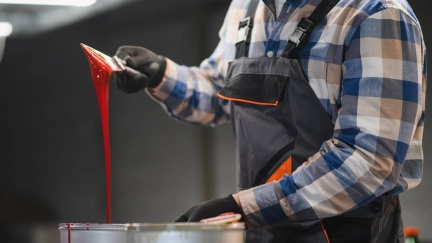
It rarely draws attention, yet screen printing is all around us, from the contact grid on a solar cell to the raised varnish on a bottle label. The process owes its place in industry above all to one quality: hardly any other printing technology lays it on so thick. Quite literally. This gives it the opacity and conductivity that many applications depend on.
Anyone sitting in a car has screen prints literally right in front of them, often without realising it. The first is the black border around the windscreen, which breaks up into fine dots towards the centre. The border consists of ceramic enamel that is printed onto the glass and then fired at over 600 °C. The enamel hides the adhesive that holds the windscreen in the car body and protects it from UV light. The dots let the black fade gently into the clear glass and reduce distortion at the edge. The second screen print catches the eye in the rear-view mirror. The heating elements run across the rear window as fine lines of conductive material, often alongside antennas for radio or GPS. Both applications need an ink layer that is thick enough to be fully opaque or to carry current. And this is the quality that almost every industrial use of screen printing depends on.
One screen, one squeegee and plenty of ink
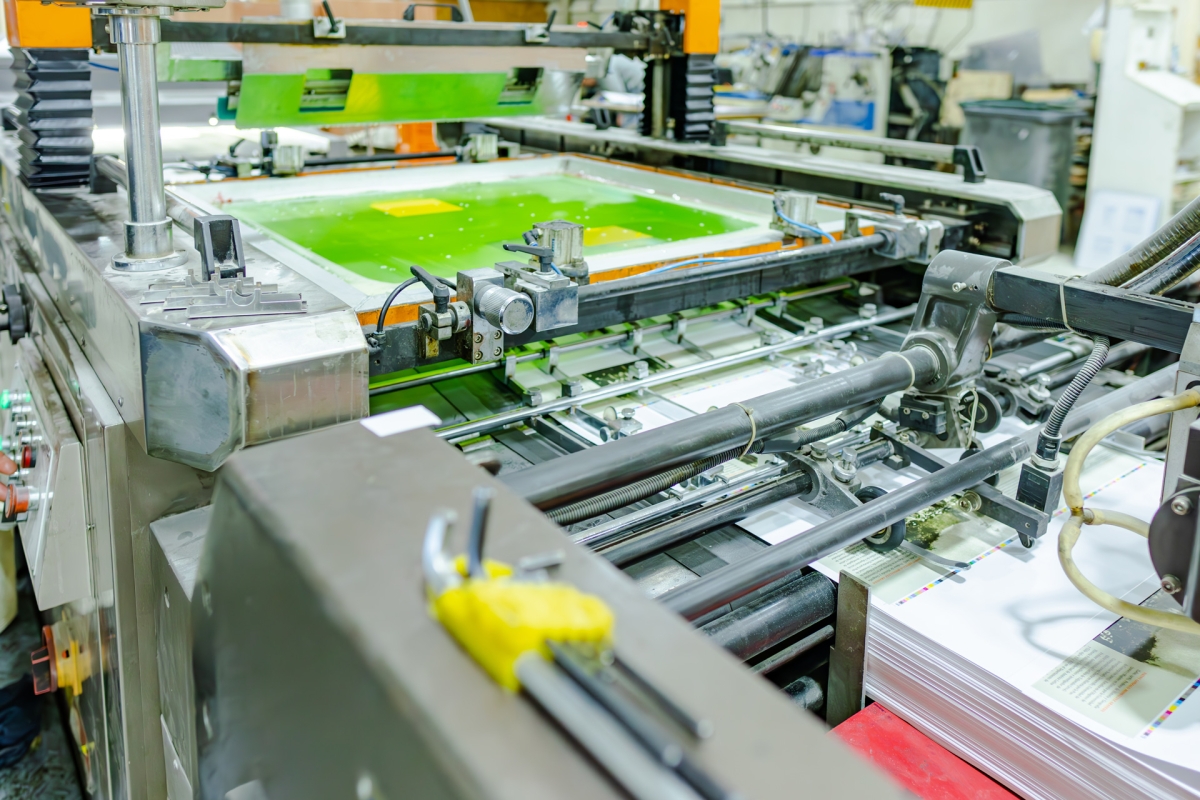
The principle of screen printing is easy to explain: ink is pushed through a fine screen onto the material being printed. The mesh contains a stencil that lets ink through only where the image is meant to appear. A squeegee sweeps the ink across the screen and presses it through the open mesh onto the material below. Mesh and stencil determine how much ink reaches the material. The range is wide: in rotary screen printing for labels, layers between 5 and 250 microns can be printed in a single pass.
While other processes transfer thin films of ink or tiny droplets, screen printing builds up material. It can also handle materials that other technologies struggle with, such as coarse effect particles or pastes with a high metal content.
On glass, the print lasts as long as the pane
The ink does not simply sit on the surface of car glass. It contains glass frit, which melts while the pane is being bent or toughened. In the process, the frit fuses permanently with the glass. Whatever is printed on the pane then becomes part of it and lasts as long as the pane itself.
Glass control panels for household appliances and other user interfaces are made in the same way. Symbols and scales are printed and fired, as are the conductive structures for the touch function. For multicolour designs, gradients and small batches, glass processors now also use ceramic digital printing. They stick with screen printing for large volumes where every part has to look the same, and wherever surfaces must be fully opaque with sharp edges. Car windows, by the way, are printed flat and only bent afterwards. If a glass part is already strongly curved, a third process is often used: pad printing. Here, an elastic pad picks up the ink and transfers it to the part. But that's another story.
Plastic parts: the decoration sits beneath the surface
On many trim panels and controls in cars, household appliances or medical devices, the decoration is hidden beneath a layer of plastic. The technique behind this is called in-mould decoration. The moulder places a printed film in the injection mould and back-moulds it with hot plastic, which bonds permanently with the film. For many years, the film has mostly been screen printed, and once again layer thickness is the deciding factor: an ink layer that is too thin would be washed out by the hot melt or would show through.
At drupa 2024, ESMA, the European Specialist Printing Manufacturers Association, gave such applications a platform of their own. “Screen printing remains the driving force behind many industrial applications,” said ESMA CEO Peter Buttiens at the time. The next step is to bring electronics into the part itself. In in-mould electronics, screen printing is first used to apply conductive tracks to the film with stretchable conductive inks. The film is then formed and back-moulded. This creates surfaces that can light up or generate heat. In the automotive sector, however, the technology has not yet made it into series production. According to market research firm IDTechEx, such applications are currently being evaluated and could reach the market in vehicles from around 2027 or 2028.
Solar cells: silver in ever finer lines
Most silicon solar cells carry a grid of ultra-fine contact fingers that collects the current. Since the 1980s, this grid has mostly been applied as silver paste by screen printing. While the fingers used to be around 100 microns wide, today they measure only about 10 to 15 microns in mass production.
Every micron counts. Silver is expensive, and the photovoltaics industry needs a great deal of it: according to the ITRPV industry roadmap, the sector accounted for more than a quarter of global silver demand in 2024. A major paste manufacturer therefore expects pastes with a high copper content to enter mass production on a large scale for the first time in 2026. These pastes are also applied by screen printing. Meanwhile, the Fraunhofer Institute for Solar Energy Systems ISE presented an electroplating process using nickel and copper in 2026 that needs only around a tenth of the silver. The researchers believe it could be ready for market in two to three years and would then offer an alternative to screen printing.
Hydrogen technology also makes use of screen printing. In a research project, Fraunhofer ISE produced catalyst layers for fuel cells and electrolysers using screen and rotary screen printing, among other methods. Both fields are part of functional printing, a broad area that we have already covered in a series of its own.
Packaging and labels: opaque white, tactile varnish and Braille
On packaging, screen printing comes into its own wherever ink needs to be especially opaque or tactile. On transparent labels, an opaque white is often printed first as a base for the other colours. The design then looks as if it had been printed directly onto the bottle: the so-called no-label look. A varnish can be felt once the layer is more than 26 microns thick. Screen printing can even apply glitter or coarse effect pigments cleanly to the label.
For medicines, tactility even becomes a legal requirement. Since EU Directive 2004/27/EC came into force, the name of the medicine and its strength must appear on the pack in Braille. A European standard sets out the requirements for the dots. The dots are applied either by embossing or, on labels for example, by screen printing with high-build varnishes.
Technical textiles: rotary screen printing for long runs
Digital printing has been gaining ground in textile printing for years. Where large volumes with high colour density and opacity are needed, however, rotary screen printing holds its own. This applies above all to upholstery and seat covers for the automotive industry and to medical textiles. For short runs and frequently changing designs, on the other hand, it is rarely worthwhile, as every colour needs its own screen.
Where screen printing reaches its limits
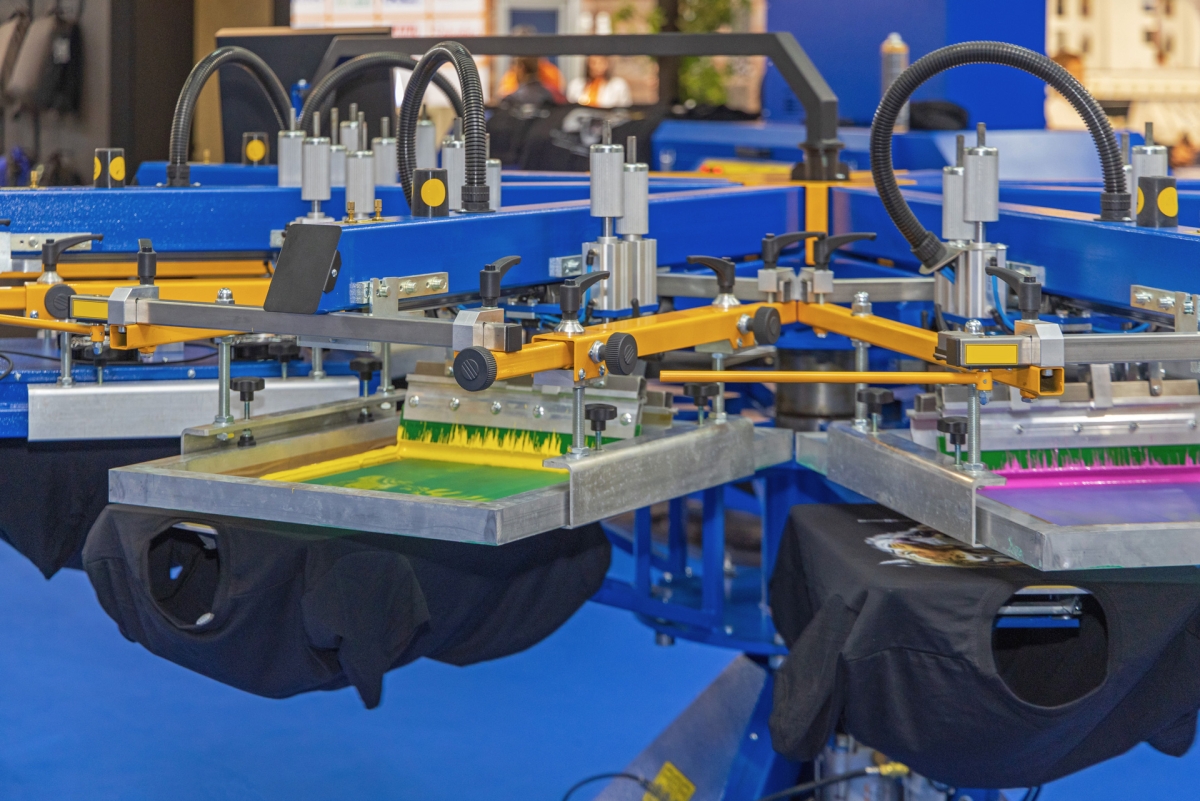
Every colour needs its own screen, and the thick layers have to dry, cure or, on glass, even be fired. Fine gradients and photographic images are difficult to reproduce. On glass, for example, screen printing achieves a resolution of only around 100 to 150 dpi. Very fine detail is quickly lost. For changing designs, one-offs, small batches or detailed images, digital processes therefore often have the edge.
But when the same layer has to sit in exactly the right place at the same thickness thousands of times over, there is little alternative to screen printing. And the further printing moves into components, energy technology and electronics, the more important this ability becomes. What industrial and functional printing applications can achieve today will be on show at drupa in Düsseldorf from 9 to 17 May 2028.
FAQ
In screen printing, a squeegee presses ink through a fine mesh. A stencil in the screen leaves open only the areas that are to be printed. The process works on paper and film as well as on glass, plastic and textiles, and it applies particularly thick layers of ink.
Typical examples include the black border and heating elements on car windows, glass control panels, decorated plastic parts, the contacts on solar cells, effects and Braille on labels, and technical textiles. What they have in common is the need for a thick layer that is opaque, conducts electricity or can be felt.
Screen printing can apply conductive silver paste precisely in very fine lines, which are around 10 to 15 microns wide in mass production today. It has been the dominant process since the 1980s. Because silver is expensive, manufacturers are working on pastes containing copper and testing electroplating as an alternative.
That depends on the screen, the stencil and the ink. According to manufacturers, rotary screen printing for labels can produce layers of between 5 and 250 microns in a single pass. A varnish can already be felt from around 26 microns, which is used for tactile effects on labels and packaging.
Screen printing plays to its strengths in large volumes and wherever a thick, opaque or conductive layer is needed. Digital printing has the edge for short runs, changing designs and fine gradients, because it needs no screen or stencil.
