A victory for print?

We’re seeing it more and more often: major retail chains are announcing that they’re doing away with printed leaflets. Their reasoning: less waste paper, less environmental impact, greater sustainability. It sounds convincing at first glance, but is it actually true? Is online marketing really more sustainable than print advertising? There is no clear-cut answer to these questions, and even upon closer examination, there is no one-size-fits-all answer. But it is possible to get closer to the truth.
There’s no question that printing consumes resources: paper, energy, ink; the transport of printed materials to readers also has a significant impact. This is usually calculated as a CO₂ balance or measured as a CO₂ footprint.
However, it is not possible to conclusively prove that the use of online media is less harmful to the environment. This is because a smartphone, e-reader or computer consumes electricity both during manufacture and whilst in use. On Google alone, for example, 3.8 million search queries are made every minute. One search query consumes around 0.3 watt-hours of electricity. Extrapolated, this means that just 20 queries already equate to the consumption of a six-watt LED bulb for one hour.
The manufacture of the hardware, the hosting of data on huge server farms, and uploads and downloads all consume energy and resources that are not always covered by ‘green electricity’. And what about recycling? That is, of course, part of the picture too: what proportion of the energy and raw materials used to produce a device can be saved or recovered through recycling? How many electronic items are actually recycled?
When it comes to recycling, paper is hard to beat
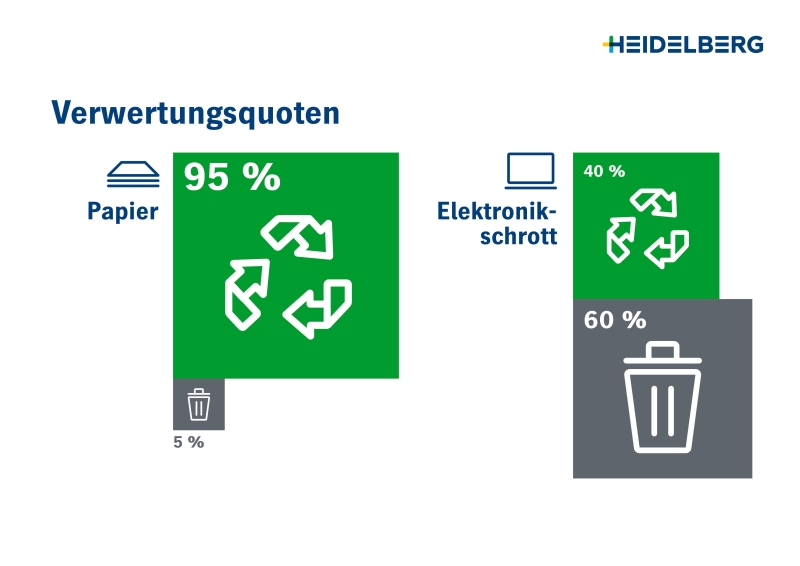
When it comes to paper, however, the facts are clear: it is a renewable raw material. The European forestry sector produces this raw material sustainably in accordance with FSC or other certified cultivation methods. Paper lends itself very well to a circular economy, and this is indeed what is being done: The waste paper recycling rate as a proportion of total paper consumption stands at over 95 per cent in Germany, and has remained stable at just over 70 per cent across Europe for around ten years.(1) Furthermore, the use of waste paper in itself further improves the CO2 footprint of paper.
When it comes to electronic media, the facts are rather vague: Greenpeace has found that global consumption of electronic hardware more than doubled between 2000 and 2015. Other sources (2) estimate that around 50 million tonnes of electronic waste are generated worldwide each year. Only a very small proportion of this is consistently recycled; in the EU, the recycling rate is just under 40 per cent. (3) This trend is continuing to accelerate: more and more digital devices are consuming ever-increasing volumes of data – and with it, energy and resources.
Which is better: postal mail or email?
A seemingly simple question. After all, emails are purely virtual, so what environmental impact could they possibly have? Yet, as already mentioned, data traffic also consumes energy and resources. The Baden-Württemberg State Agency for the Environment has published an expert estimate according to which a single email sent causes, on average, CO₂ emissions of around 10 grams, whilst a standard letter (including production, printing and postage) causes around 20 grams.(4) A narrow victory for email! Really?
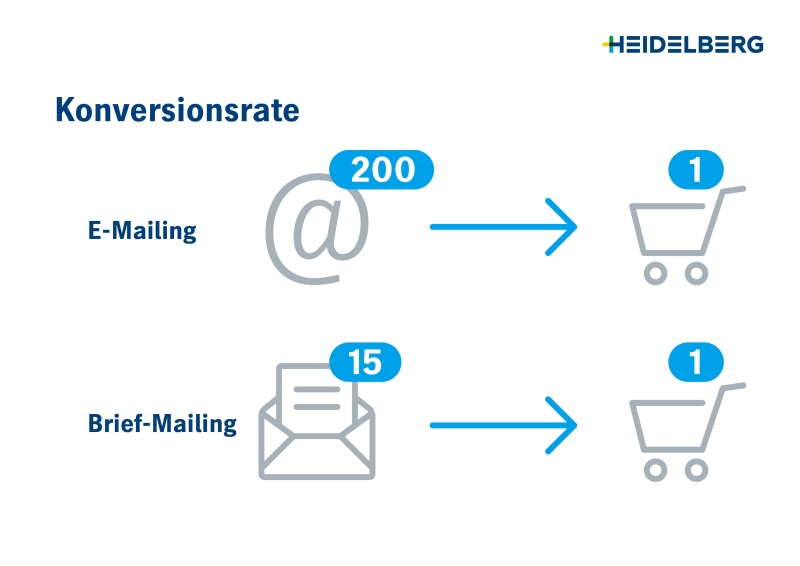
Mailing lists tend to become bloated and are rarely purged of ‘inactive subscribers’. And people are often put in ‘Cc’ who may only be vaguely interested in the content of an email. It doesn’t cost any postage, but it does consume energy. The CO2 benefit of sending emails therefore quickly evaporates if mailing lists grow out of all proportion or emails are not sent in a targeted manner. Of course, nobody wants to go back to the age of the stagecoach, but it certainly doesn’t harm the environment to prioritise quality over quantity more often when sending emails.
Deutsche Post, in collaboration with a marketing institute (5), has published a study on mail order. It compares the success of print mailings with that of email campaigns. The result: to generate the same number of orders, you could send 200 emails, which – according to the calculations made earlier – would cause approximately 2,000 grams of CO2, or 15 promotional letters, which would then emit a total of just 600 grams. So, in this case, it’s a clear win for the print product. It is also important to note – quite apart from the sustainability aspect – that leaflets, for example, continue to be used extensively as an advertising medium despite growing digital competition, and usage is even showing a slight upward trend: print works!
Ultimately, the answer is: it depends

Other research institutes have also concluded that printed media do not automatically have a worse environmental footprint compared to their digital counterparts. Arguments include the fact that a print medium consumes resources and energy only once during its production, but can be used multiple times. Ultimately, it depends on the specific use case in terms of actual usage, the materials used, transport routes and other factors. The repeated use of digital media consumes energy every time the data is accessed. An important insight, however, is that there are no automatic rules, and print can be a sustainable component of communication, clearly on a par with online communication.
Print production is constantly improving its energy efficiency
Furthermore, the printing industry is constantly evolving, and both machine manufacturers and print shops have long since made sustainability a priority. Lower energy consumption not only contributes to a better environmental footprint but also to reduced operating costs. “Sustainability and energy efficiency have now become crucial competitive and cost factors for providers in the print media industry – this applies equally to our customers and to HEIDELBERG as a company,” says Dr Ludwin Monz, CEO of HEIDELBERG.
Innovations are therefore increasingly aimed at reducing Scope 3 emissions on the user side, as these represent the greatest lever for reducing HEIDELBERG’s overall CO₂ footprint. Just one example among many is the comparison of a Speedmaster CD 102-6+L from 1990 with the current Speedmaster XL 106-6+L: Through continuous innovation and system improvements, energy consumption per 1,000 sheets has been reduced from 13.8 kWh to 8 kWh – a reduction of 40 per cent. Furthermore, HEIDELBERG aims to be climate-neutral at its sites (Scope 1+2) by 2030 and to offset unavoidable emissions. By 2040, HEIDELBERG (Scope 1+2) then aims to achieve climate neutrality without the need for offsetting measures. The company’s vision is to have the smallest environmental footprint in the industry across the entire value chain.
Sources
(1) https://www.umweltbundesamt.de/bild/tab-papiererzeugung-papierverbrauch https://de.statista.com/statistik/daten/studie/168479/umfrage/recyclingquote-von-altpapier-in-europa-seit-1991/
(2) https://twosides.info/electronic-communication/
(3) https://de.statista.com/themen/8463/elektroschrott/#topicOverview
(4) Internationally recognised estimate, e.g. by the German Council for Sustainable Development of the German Society for International Cooperation
FAQ – Frequently Asked Questions
There is no one-size-fits-all answer to this. The environmental impact depends, amongst other things, on print run, materials, transport, lifespan, data traffic, end devices and recycling
Paper is made from a renewable raw material and can be recycled several times. However, a reliable assessment also depends on its origin, certification, type of paper, printing process and disposal.
A single email generally causes fewer emissions than a printed mailing. However, if large, unrefined mailing lists are used and many messages are sent without a specific target audience, this advantage may be reduced. The conversion rate is also a key factor.
Key factors include material and energy consumption, production processes, transport routes, intensity of use, the lifespan of end devices, data transmission and recycling. It is therefore always important to consider the specific communication context.

