Gutenberg’s Inventions – Part 4: The Square and Typesetting
In our series, guest author Dr Julia Bangert from the International Gutenberg Society in Mainz e.V. is gradually introducing the inventions of Johannes Gutenberg. The fourth part deals with the angle hook and typesetting.
The typesetter’s task is to assemble the individual letters into a text. In Gutenberg’s day, typesetters were highly educated, as they had to be able not only to read but also to understand Latin. The many different special characters mentioned in the previous instalment also placed high demands on the typesetter, who had to know how to use them correctly.
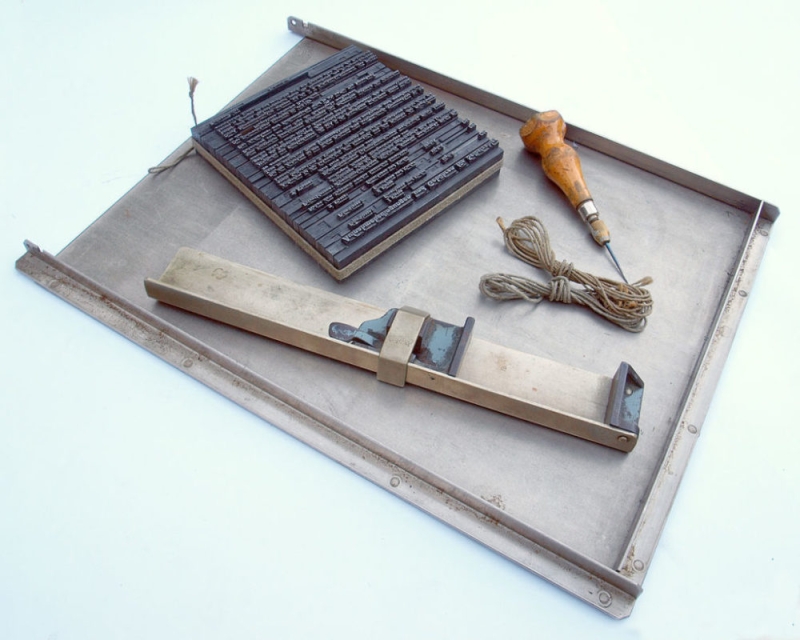
A text is set line by line. To do this, the typesetter holds the so-called angle hook in one hand and uses the other hand to retrieve the required letters from the type case. He must take great care, as the letters are mirror images and he has to place them upside down into the angle hook. The typefaces have a notch for this purpose – known as the ‘signature’ – which the typesetter uses to feel for the correct alignment. When the line is almost full, he must ‘close it out’, which means filling the spaces between the words with filler material. Early angle hooks were probably made of wood and had a fixed width. Today, an angle hook is made of metal and the desired line width can be set in advance using an adjusting screw.
The typeset
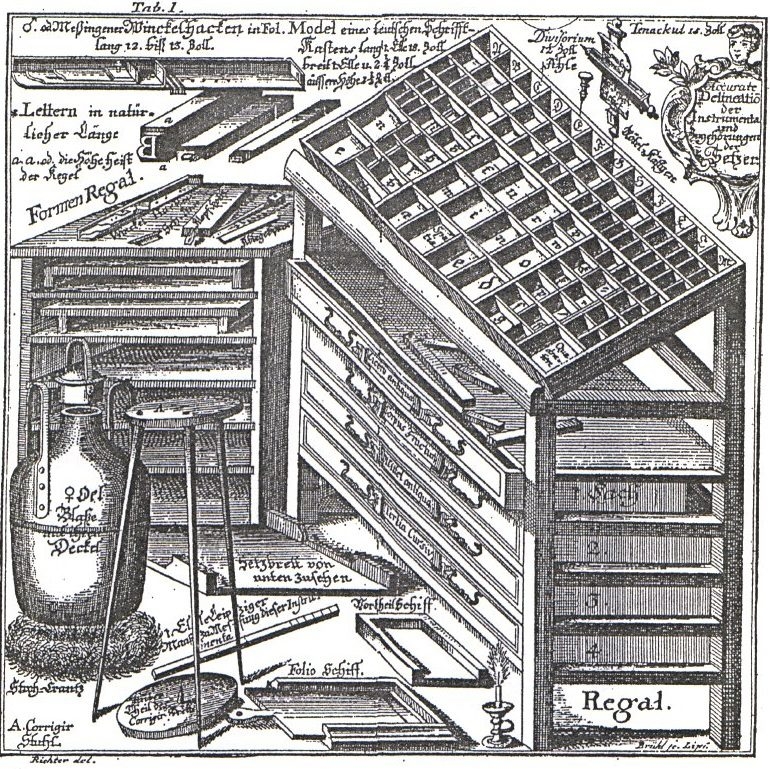
Christian F. Gessner, “The Art of Printing and Typefounding: Both Necessary and Useful, Illustrated with its Typefaces, Formats and All Associated Instruments, Clearly Described, and Accompanied by a Concise Account of the Origin and Development of the Art of Printing”, 1740, p. 226f
The completed lines are assembled in the typesetting tray to form a complete page of text. The typesetting tray consists of a simple plate with a rim on three sides and open on one side. The spaces between the lines—the leading—are also filled with filler material. Next, the entire composition is bound together so that all the type remains in place during transport. This process is known as binding. To do this, a cord – the so-called column cord – is wound several times around the finished composition. The end is threaded through the coils using a typesetter’s awl and pulled tight. The awl is a tool with a wooden handle and a narrow metal tip. The typesetter can also use it to make corrections to the composition by pulling out individual misplaced letters with the tip. From the typesetting table, the finished standing composition is then transferred to the printing press and is ready for the next step.
FAQ – Frequently Asked Questions
An angle square is a tool in which typesetters assemble individual letters into a line of text. The letters are inserted upside down and with the sides reversed.
The letters have a small notch, known as the ‘signature’. This helps the typesetter to feel for the correct orientation of the reversed letters.
Spacing involves filling the gaps between words with filler material. This brings a line of text to the desired width.
A typesetting tray is a flat board with raised edges on which several set lines of text are assembled to form a complete printed page. The typeset is then bound and taken to the printing press.

About the author:
Julia Bangert holds a Ph.D. in Book Studies and is an artist. In 2019, her dissertation was published under the title 'Book Trade System and Knowledge Space in the Early Modern Period.' She works freelance as a book painter and illustrator. Her signature style features the finest use of color and an elegant brushstroke, with perfect gold leafing as her passion.
One of her ongoing projects is the illumination of Bible pages, which can be purchased in the shop at the Gutenberg Museum in Mainz.