All production print trends point to inkjet

The production print landscape is changing at a dramatic pace. Here at Kyocera, we are helping our customers prove that constant innovation is the new “business as usual” for those who aim to unlock new growth.
Now, with drupa 2024 on our doorstep, let’s look at some key trends that will determine business success in production printing and examine why inkjet technology is the ready-made solution to address existing challenges and take advantage of exciting new opportunities.
The rise of water-based inkjet
Inkjet is, in my opinion, one of the most disruptive technologies to enter the production print market in the past decade. Traditionally a toner-dominated industry, inkjet has arrived to redefine the landscape of commercial printing
and in-plant operations at a time when the need for more varied and personalised communication has never been greater. The properties of water-based inks are already delivering huge benefits for commercial and in-house printers alike, particularly in areas such as productivity, output quality, and finishing capabilities. The primary advantage of pigment-based inkjet inks is their permanence – independent tests have estimated that, depending on the environmental conditions, prints made with pigment-based inks can keep their colour for decades. With good adhesion and drying properties, water-based inkjet is suitable for printing on many surfaces, thus increasing the range of media types that can be handled. Due to their water-based nature, these cost-efficient inks offer sustainability without sacrificing quality or productivity. Moreover, inkjet is – compared to other printing technologies like offset or toner based – a true non-contact printing technology. This is favourable for handling media without difficult circumstances like pressure, friction and excessive heat like in other technologies. Inkjet printing, therefore, offers big advantages for handling different media types without complications.
Added-value media versatility
Customer needs are evolving, and production print operations need to be more versatile than ever. 2024 and beyond will reward those who stand out in terms of workflow flexibility. For commercial printers, media types and volumes are changing. The workflows of in-plant operations, too, continue to be conditioned by increased digitalisation. I can only see these trends being accelerated further during the year ahead, and the best way to combat the uncertainty associated with such rapid and aggressive change is to become more flexible and adaptable than ever. We believe that this is where inkjet technology will come into its own, particularly in markets such as direct mail, transactional printing, and graphic arts. Markets will likely see the demand for short-run, personalised jobs increase throughout 2024 and into 2025. At Drupa, Kyocera will show why inkjet technology makes it conducive to driving productivity during times of uncertainty.
Sustainable operations
Sustainability is taking on greater importance among today’s customers – many are now actively seeking to do business with organisations who they perceive to be sustainable. At Kyocera, we believe that long-term success cannot be achieved without sustainability. Staying true to the philosophies of our founder Dr. Kazuo Inamori, we strive to do the right thing as a human being – that’s why we place sustainability at the heart of our innovation. This enables us to continue meeting the changing needs of Kyocera customers while ensuring we contribute to the world around us. Our rapidly growing portfolio of environmentally responsible inkjet technology shows how serious we are about walking the walk.
As we will demonstrate at Drupa 2024, the TASKalfa Pro 15000c and TASKalfa Pro 55000c have been designed to minimise wastage and maximise the sustainability of the production flow of Kyocera customers. These devices ensure that there is no running in at the start of production nor are test sheets or daily calibrations needed, and this is all underpinned by the intelligent control of the paper path. What’s more, their few moving components contribute to a long lifecycle and these machines also contain reusable parts, while yielding minimal disposable waste during operation. At drupa, Kyocera will also detail how it’s possible to achieve high productivity levels with low energy consumption. We will demonstrate the stunning output of the TASKalfa Pro 55000c, on vibrant graphic arts materials that use water-based inks. Robust devices that minimise energy consumption and waste will come to the fore in 2024. With our growing portfolio of inkjet technology, Kyocera will continue to demonstrate the value of energy-efficient technology, environmentally safe aqueous inks, and parts that require minimal maintenance – with our TASKalfa Pro range, businesses no longer have to choose between productivity and sustainability.
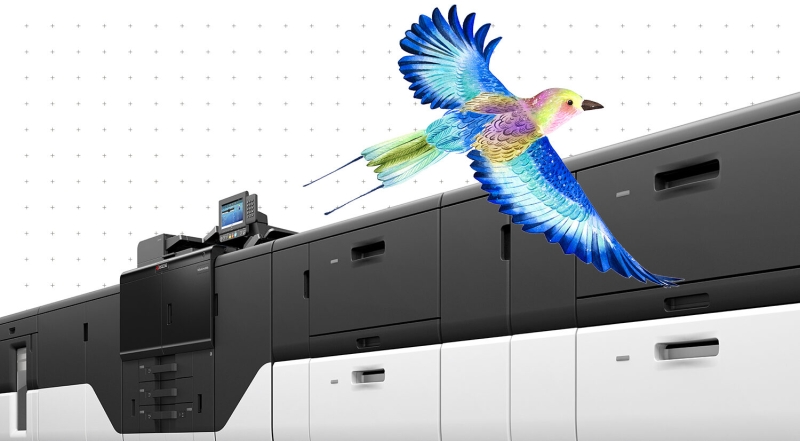
TASKalfa Pro 15000c
The rise of partnerships
The year ahead will reward businesses that work together with their technology providers. Partners who understand current challenges and new opportunities can provide the perfect technology to minimise the former and maximise the latter. Teaming up with Kyocera gives partners access to our extensive knowledge and experience with inkjet technologies. Compared to others that have fallen into the status quo over the years, with inkjet we can create a strategy that is tailored to the opportunities of today. Our partnership-focused approach is one thing that sets us apart. Guided by core philosophies such as transparency, Kyocera is determined to create close and enduring partnerships with dealers, partners and end-customers. Kyocera is determined to ramp up growth in the production print market, something which can only be achieved with a strong network of partners and customers. Furthermore, Kyocera products are designed to grow alongside businesses, to help customers unlock their true potential. During Drupa 2024 and the months that follow, it will become clear that inkjet is the major trend in production printing – we truly believe that it is the future of the industry. With unrivalled knowledge, experience, and solutions, Kyocera is the perfect partner for businesses looking to drive new business growth in production print.
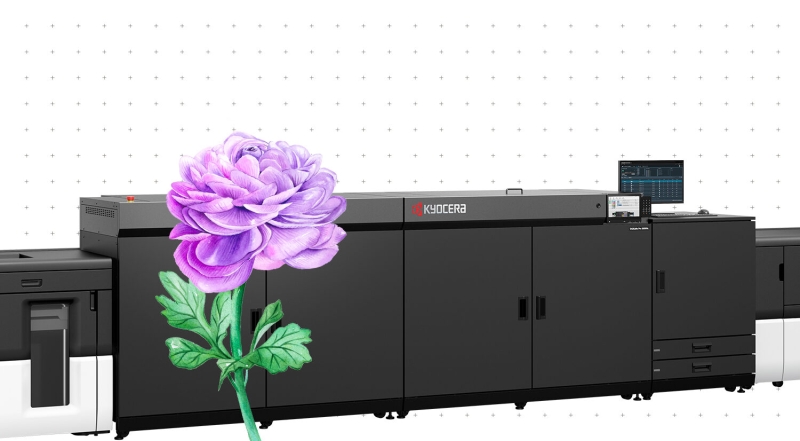
TASKalfa Pro 55000c
Automation-driven productivity
As turnaround times continue to tighten, device uptime will be a major determinant of success in production print during 2024. The value of workflows that flow without fail is becoming more important. Reliable technology, remote maintenance, and streamlined software solutions that facilitate end-to-end workflows will be just some of the productivity-related trending topics during the next 12 months.
Key to automation is reliable technology that works when you need it most. With unrivalled reliability, Kyocera’s inkjet portfolio, with 95%+ uptime, is ready to help businesses elevate productivity by leveraging the following features:
- A variety of software solutions at the pre-press side, along with a choice between front-end systems gives the customer a multitude of options to streamline the document workflow from end to end.
- Remote servicing means troubleshooting can be carried out remotely in real time, reducing technician site visits.
- Kyocera’s TASKalfa Pro devices can be connected to a variety of in-line finishing partner solutions that facilitate end-to-end automation and production flow efficiency.
- Few moving parts and less wear because of the lack of friction minimise the risk of production interruptions, thus optimising uptime.
- The options to add feeding and stacking units to Kyocera devices enhance the timeframe for unattended printing and offer flexibility in changing media types while producing. This enables the operator to prepare the engine for the next job, while the current job is still running.
Staying true to the mantra "prevention is the best form of cure," Kyocera's robust inkjet production printers have been built to thrive in the most demanding work environments where both quality and quantity are paramount.
It is precisely this reliability that enables workflow automation across media types, facilitating priceless versatility when it comes to meeting the changing needs of customers.

TCO/ROI-focused decisions
With running costs rising, the margins are tightening across the board. The cost
of inefficient technologies will become increasingly evident during the year ahead – as will the huge benefits to be had with cost-effective inkjet production printers. With the cost of doing business rising, the pressure on companies to seek new ways of reducing expenses is following suit.
Contrary to the long-held belief that reducing investments in new tools is the surest way of saving money, the reality of the past couple of years has told us a different story: sticking with unreliable or inefficient technology is by far the more expensive play in the long run. Users of Kyocera’s TASKalfa Pro 15000c, for example, have already seen the huge potential of inkjet, both in terms of driving productivity and keeping running costs under control.
Finally, the year ahead will further underline the fact that total cost of ownership (TCO) and return on investment (ROI) are finely intertwined. A low purchase price, however, does not guarantee a low total cost of ownership over the life cycle of a device, nor a strong return on investment. TCO provides an overview of the total expenses that a printer will accumulate throughout its lifecycle – this is the true figure that allows us to calculate the return on investment of a production printer. When taken alone, a product’s acquisition price only tells part of the story: the start. With its cutting-edge yet affordable technology, Kyocera’s inkjet portfolio proves that it’s possible to minimise running costs (for an appealing low TCO) while expanding business capacities (for a short ROI).
Driven by long-lasting technology that enables businesses to do more with less, Kyocera is ready to work with even more businesses in 2024 and beyond, to help them optimise productivity and cost savings.
FAQ - Frequently Asked Questions
Inkjet enables high productivity, flexible applications and printing on a wide range of media. It is particularly suitable for personalised products, short runs and varied production requirements.
Water-based inkjet inks can provide high print quality, good adhesion and efficient production processes. They are also suitable for different media types and can support more sustainable production operations.
Inkjet can help reduce waste, test sheets and unnecessary production steps. Combined with automated workflows and lower energy and maintenance requirements, it can make production processes more efficient.
Automation can improve utilisation, reduce manual tasks and help minimise downtime. Total cost of ownership (TCO) considers not only the purchase price but also the operating costs over the entire lifecycle of a printing system.

