Modern Flexo Maximizes Returns in the Press Room

Packaging printers and prepress specialists today are looking to get more out of their flexo production. New technologies and techniques are driving flexo to a higher standard for packaging printing, transitioning flexo from craft-based to a more standardized, sustainable manufacturing process.
In the last 4 years, the packaging printing industry has been through constant change due to various pressures including Covid, supply chain crisis and inflation. While these pressures have begun to stabilize, brands continue to focus on continuity of supply, driving more efficient SKUs, as well as prioritizing sustainability to protect the environment, which is driven by the consumer. The needs of the brands are creating increasing requirements for printers to be more efficient and sustainable in their production.
Fortunately, at the same time, new technologies and techniques are driving flexo to a higher standard for packaging printing. Flexo is evolving from its ‘traditional’ capabilities, practices and processes to a new era of what we at Miraclon call modern flexo that is a standardized, sustainable manufacturing process. The lack of skills in the industry, combined with the pressures on printers to increase yields and implement sustainability improvements necessitates less ‘craft’, and more efficient, intervention-free printing that can cope with the full range of client demands.
Modern Flexo — standardized and sustainable manufacturing
Modern flexo describes a production state where
- Flexo can achieve visual parity with gravure, offset and digital.
- Results are consistent and predictable enough to enable printing by numbers.
- Jobs are printed with as few colors as possible (more process, less spots)
- Print conditions offer wide print latitude and facilitate clean printing.
- Outcomes can be optimized in more challenging environments, including — crucially — with more sustainable materials.
As a result, printers that implement modern flexo benefit from increased uptime, less troubleshooting, reduced waste, and more efficient job scheduling. They are positioned to commercialize more sustainable offerings and compete for work traditionally printed with other print processes.
The plate is the catalyst
While implementing modern flexo practices requires collaborative effort between the printer and their key suppliers — press, ink and anilox manufacturers and prepress providers have all innovated steadily over the last decade and a half — it is the flexo plate that sits at the center of the flexographic print process. The plate brings together substrates, inks, tape and anilox, influencing press capability and results, and is the key enabler of best-in-class flexo printing that is highly consistent in the press room.
Miraclon is a key enabler of Modern Flexo, through our innovative and differentiated FLEXCEL NX Technology and applications expertise.
Our proprietary FLEXCEL NX technology makes possible the ultimate control of ink transfer on which modern flexo is founded, and which is enabled by advanced plate surface patterning. The surface of a FLEXCEL NX plate incorporates digitally imaged surface channels that enable the ink to flow. The channels are just 4-6 microns wide — there are 6 channels in the width of a human hair — and can be modified for different applications and different combinations of presses, substrates, inks and aniloxes. Advanced plate surface patterning can only be achieved through Miraclon’s unique imaging and plate making technology that eliminates variables from the plate making process.
Continuing innovation
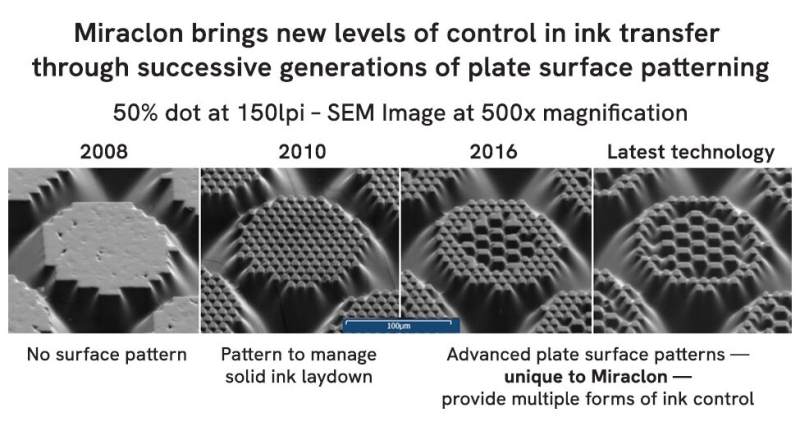
Over the years successive iterations of our plate surface patterning technology have brought new levels of control in ink transfer, improving the quality, predictability and consistency of flexo printing. The scanning electron microscope (SEM) images in the illustration below clearly show the progression.
The most recent iteration — brought to market as PureFlexo™ Printing — specifically tackles unwanted ink spread, which puts pressure on the production process, often leading to lower press speeds, more frequent unscheduled stoppages to clean plates, and a general reduction in press setup latitude. Wide print latitude is key to profitable production: less latitude, and the more likely that a small change in printing conditions will affect quality and result in reduced productivity, increased time and material waste.
Real-world results
The best way to understand the impact of modern flexo is to see it in action. Miraclon is a key enabler of the transformation to modern flexo, and at drupa we’ll be highlighting 12 case studies of printers that have made that transformation. Each of them has used FLEXCEL NX technology to change the way they print and realize significant financial and sustainability benefits. The benefits are quantified, and the case studies cover a range of packaging applications and challenges from around the world. We invite printers to visit the Miraclon stand to learn how implementing modern flexo can help them meet their efficiency, sustainability and quality goals.
FAQ - Frequently Asked Questions
A distributed book printing network connects qualified print service providers in different regions. This allows books to be produced closer to the point of sale and according to actual demand.
Regional production and print-on-demand can help reduce transport distances, overproduction, inventory and returns. This may lower material consumption and emissions.
Print-on-demand enables publishers to produce books based on actual demand. This reduces the need for pre-production and storage while keeping niche titles and smaller print runs economically viable.
A digital platform can connect ordering, file transfer, production, invoicing and logistics. Standardised processes and validated print partners make it easier for publishers to work across borders.

